
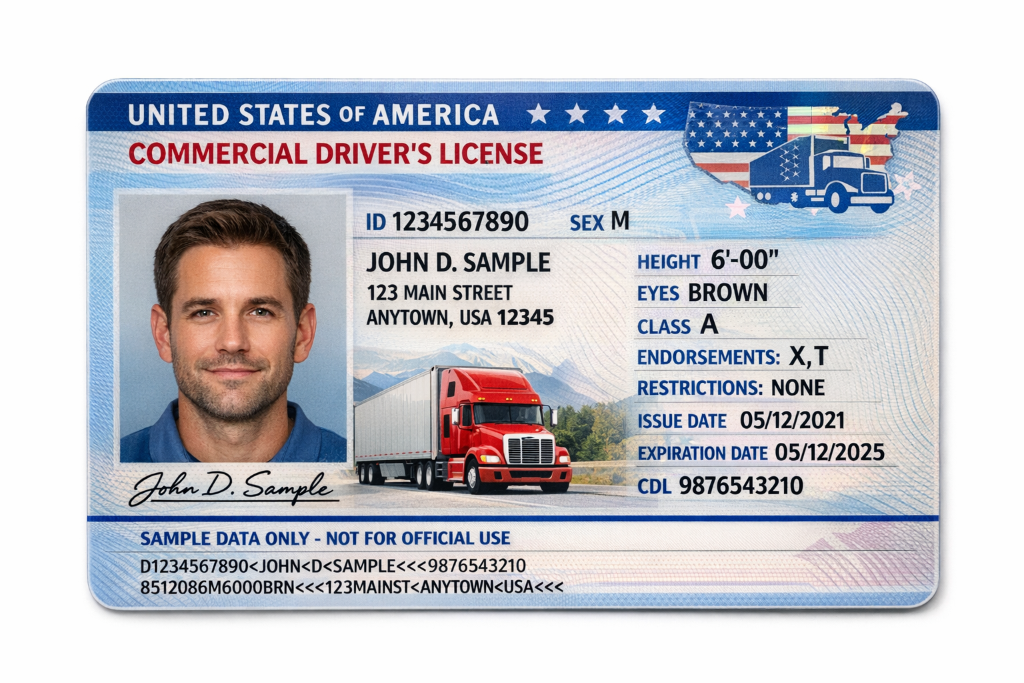
Every day, thousands of commercial loads are handed over to drivers presenting a Commercial Driver's License. Most are legitimate. But a growing number are not — and the industry is only beginning to grapple with the consequences.
Fraudulent, suspended, and falsified CDLs are being used to gain access to freight across the United States. In some cases, drivers present licenses issued in states where they've never lived. In others, CDLs that were suspended or revoked in one state remain active-looking in another due to gaps in the interstate data-sharing system known as the Commercial Driver's License Information System (CDLIS).
The Problem with Paper
At most pickup locations today, license verification is a visual inspection. A dock worker or security guard glances at a card, checks the name against a load assignment, and waves the truck through. There is often no real-time lookup against federal or state databases.
This creates an obvious vulnerability. A high-quality counterfeit CDL — or a license that was revoked last week — can pass a visual check with no problem.
How Suspensions Fall Through the Gaps
The CDLIS system was designed to prevent drivers from holding CDLs in multiple states simultaneously. But the system has known limitations:
- State-to-state reporting delays can leave revocations unrecorded for days or weeks
- Drivers who obtain licenses fraudulently in one state may not appear flagged in another
- Some violations in non-CDL vehicles are not always properly linked to the commercial license record
The result is that a driver who should not legally be operating a commercial vehicle may still present what appears to be a valid credential.
What Carriers Are Legally Required to Do
FMCSA regulations require carriers to conduct a pre-employment driving record check and annual reviews thereafter. However, these checks are periodic — not real-time. A driver whose CDL is suspended between annual reviews may continue operating without the carrier's knowledge.
The gap between when a suspension occurs and when a carrier finds out is where the industry's liability exposure lives.
Technology Closing the Gap
A new generation of driver verification platforms is working to address this. Solutions from companies like CDL-Driver Verify provide real-time or near-real-time license status checks, linking driver identity to current FMCSA and state DMV records at the point of dispatch or pickup.
These tools don't replace regulatory compliance — they augment it, giving carriers, brokers, and shippers a layer of due diligence that paper-based processes simply cannot provide.
The Bottom Line
A driver with a fraudulent or suspended CDL is not just a regulatory problem. They represent a safety risk on public roads, a cargo security risk at the dock, and a significant liability exposure for every party in the chain of custody.
Verification is not just good practice. Increasingly, it's the baseline standard that insurers, shippers, and regulators expect.